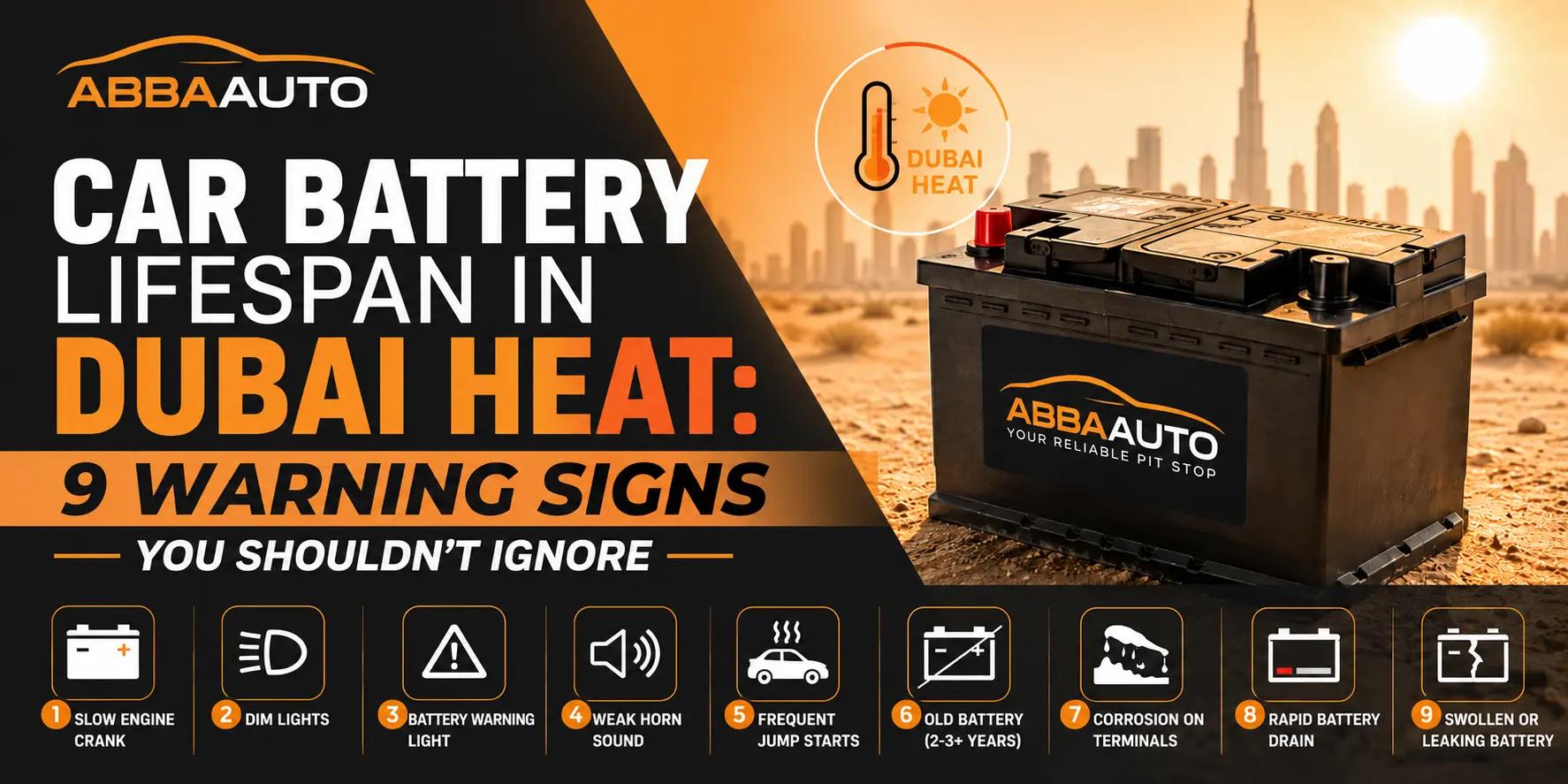
Car Battery Lifespan in Dubai Heat: 9 Warning Signs You Shouldn't Ignore
Quick answer
In Dubai's climate, a conventional lead-acid car battery typically lasts 18–24 months, roughly half to a third of the 3–5 years you'd get in a temperate country because sustained heat above 40°C accelerates internal water loss and plate corrosion. The clearest warning signs are a slow or hesitant crank, a lit dashboard battery symbol, dimming headlights, a clicking sound at start-up, and a visibly swollen battery case. If you notice any one of these, get the battery load-tested within days, not weeks: in UAE heat, batteries tend to fail suddenly once they cross the danger threshold, with little extra warning after the first symptoms appear.
Why Dubai's Heat Is Uniquely Hard on Car Batteries
Most drivers assume cold weather is what kills a [car battery](https://www.abbaauto.ae/car-service-repair/car-battery-service/) and in most of the world, that's true. Whereas it's the opposite in Dubai. Heat, not cold, is the dominant cause of premature battery failure, and the mechanism is chemical, not mysterious.
A lead-acid battery generates power through a chemical reaction between lead plates and a sulfuric acid electrolyte. That reaction is temperature-sensitive: higher heat speeds it up. This sounds beneficial, a faster reaction should mean more power but the side effects are what shorten the battery's working life. Elevated under-bonnet temperatures cause the water portion of the electrolyte to evaporate faster than normal, expose more of the internal lead plates to air, and accelerate corrosion of the plates and internal connectors. Once enough water is lost and enough plate area is corroded, the battery can no longer hold a full charge, even if it still starts the car on a good day.
Battery engineers commonly use a rule of thumb to describe this relationship: for roughly every 15°C a battery's average operating temperature sits above the 25°C baseline used in most manufacturer ratings, its usable life is cut roughly in half. Under a Dubai bonnet in July and August, engine-bay temperatures regularly run 20–30°C above ambient air temperature, which itself is already well past 40°C for weeks at a time. That combination is why a battery rated for 4–5 years by its manufacturer routinely fails in the UAE within two years.
Dubai's temperature reality, month by month
Month
Average high
Battery stress level
January
~24°C
Low
April
~34°C
Moderate
June
~39°C
High
July–August
~40–42°C (peaks above 48°C inland, engine-bay temps significantly higher)
Severe
September
~39°C
High
November
~30°C
Moderate
Notice that Dubai spends roughly five consecutive months, May through September with daytime highs above 34°C. In most countries where manufacturer battery ratings are calculated, that kind of sustained heat load simply doesn't happen. That's the core reason generic, imported battery-life estimates don't hold up on UAE roads, and why local replacement guidance always lands well below the global average.
How Long Do Car Batteries Actually Last in Dubai?
There's no single number that applies to every car, but workshop experience across Dubai points to a consistent pattern by battery chemistry:
Battery type
Typical life (temperate climate)
Typical life in Dubai
Standard flooded lead-acid
3–5 years
18–24 months
Enhanced Flooded Battery (EFB)
4–6 years
2–3 years
AGM (Absorbent Glass Mat)
5–7 years
3–4 years
Two driving habits common in Dubai compress these numbers further, regardless of battery type: short stop-start city trips that never let the alternator fully recharge the battery, and long hours parked in direct sun without shade, which raises the battery's resting temperature even when the engine is off.
The 9 Warning Signs of a Failing Battery in Dubai Heat
Heat-damaged batteries in the UAE rarely fail without any notice but the notice period is often short. Once one of these signs appears, workshops in Dubai generally see a battery fully fail within one to six weeks, not months. Treat any single item on this list as a reason to get tested, not a reason to wait for a second symptom.
1. Slow or hesitant engine cranking
This is almost always the earliest sign. A healthy battery delivers a sharp, confident crank; a weakening one produces a brief hesitation or a slower turnover, most noticeable on the very first start of the day before the engine bay has heated up.
2. A dashboard battery warning light
This icon can indicate either a battery problem or a charging-system (alternator) fault, so it should never be dismissed as “probably nothing.” A light that stays on after the engine has started, rather than switching off within a few seconds, points to a voltage issue that needs diagnosis.
3. Dimming headlights or interior lights
If your headlights noticeably dim at idle, or the dashboard and interior lights look duller than usual especially with the AC and other accessories running, the battery may no longer be supplying stable voltage under load.
4. A clicking sound instead of a smooth start
A rapid clicking noise when you turn the key or press the start button usually means the battery has enough charge to engage the starter relay but not enough to actually turn the engine over.
5. A swollen or bloated battery case
Heat causes internal gas build-up, and a case that looks bulged or rounded on the sides is a sign of real internal damage, this is a safety issue, not just a performance one. A swollen battery should be replaced immediately rather than monitored.
6. Corrosion on the terminals
A chalky white, blue, or greenish crust around the battery terminals restricts the electrical connection and is accelerated by Dubai's combination of heat and humidity. Visible corrosion is a sign the battery is under stress even if the car is still starting normally.
7. A rotten-egg smell near the engine bay
A sulfurous smell can indicate the battery is overheating internally or venting gas, treat this as an immediate inspection trigger, and avoid prolonged exposure to the fumes.
8. Electrical accessories behaving erratically
Power windows moving slower than usual, an infotainment system that restarts or glitches, or intermittent warning lights across the dashboard can all point to unstable voltage from a weakening battery, particularly under the heavy electrical load of continuous AC use in summer.
9. The battery is 18+ months old and you've already needed one jump-start
Age plus one prior jump-start is a strong combined signal in Dubai's climate. A battery that has already needed external help once is very likely to fail again soon, and testing at this point is far cheaper than a breakdown.
How to Test Your Battery at Home
A basic multimeter reading takes under two minutes and gives a reasonably reliable first indication of battery health, though it isn't a substitute for a full workshop load test.
Reading (engine off)
What it means
12.6V or higher
Fully charged, healthy resting voltage
12.2V – 12.5V
Partially discharged; monitor and consider a recharge
11.9V – 12.1V
Significantly discharged; have it load-tested soon
Below 11.9V
Likely failing or damaged; workshop inspection recommended promptly
Take this reading with the engine off and the car unused for at least an hour, since a reading taken right after driving will be artificially high from residual alternator charging. A voltage reading alone can't detect internal plate damage or reduced capacity, which is why a professional load test remains the more reliable check once you're within the 18–24 month replacement window.
Battery Types Compared for UAE Driving
If you're due for a replacement, the battery chemistry you choose matters more in Dubai than almost anywhere else, because heat resistance directly translates into extra working months.
Type
Heat resistance
Best for
Trade-off
Standard flooded lead-acid
Lowest
Older, non start-stop vehicles on a budget
Shortest life in UAE heat
EFB (Enhanced Flooded Battery)
Moderate
Entry-level start-stop systems
Mid-range cost and lifespan
AGM (Absorbent Glass Mat)
Highest
Modern start-stop vehicles, high electrical loads
Higher upfront cost, best cost-per-year
Always check what your manufacturer specifies before switching types, vehicles with start-stop systems in particular are often designed around EFB or AGM electrical characteristics, and fitting a standard battery can cause the start-stop feature to malfunction or disable itself.
7 Ways to Extend Battery Life in Extreme Heat
Here are some of the most common ways to [protect your car battery from Dubai heat](https://www.abbaauto.ae/blog/protect-car-dubai-heat/):
- Park in shade or use a windshield/car cover. Even a few degrees of difference in resting temperature measurably slows internal water loss over months of parking.
- Get the battery load-tested twice a year; ideally in April, before peak summer, and again in October, once the worst heat has passed.
- Keep terminals clean and free of corrosion. A five-minute check during any routine service can catch early corrosion before it affects the connection.
- Avoid letting accessories run with the engine off. Headlights, interior lights, or a phone charger left on while parked draw down the battery without any recharging from the alternator.
- Take longer drives periodically, not just short stop-start city trips, so the alternator has enough time to fully recharge the battery.
- Have the charging system tested alongside the battery. A weak alternator forces the battery to work harder and can shorten its life even if the battery itself is otherwise healthy.
- Choose a heat-appropriate battery type (EFB or AGM) at your next replacement rather than defaulting to the cheapest standard battery.
## What Happens If You Ignore the Warning Signs
A failing battery rarely stays an isolated problem. In UAE conditions, the knock-on effects tend to show up faster than drivers expect:
- Alternator strain: a weak battery forces the alternator to compensate constantly, which can shorten the alternator's own lifespan and alternator replacement typically costs significantly more than a battery swap.
- Starter motor wear: repeated slow cranking puts extra mechanical load on the starter motor, increasing the risk of premature starter failure.
- Unstable voltage to electronics: irregular voltage delivery can affect sensitive components such as the ECU, infotainment system, and sensors, occasionally causing electrical faults that are more expensive to diagnose than the original battery issue.
- Sudden, no-warning failure: once a heat-damaged battery crosses a certain degradation threshold, it can go from “seems fine” to “completely dead” within days, often in a parking lot in the middle of summer, which is the worst possible time and place for it to happen.
## What Does Battery Replacement Cost in Dubai?
Pricing varies by vehicle make, battery brand, and chemistry (standard, EFB, or AGM), so treat any number here as a general guide rather than a quote. As a rough starting point, standard batteries sit at the lower end of the market, EFB batteries in the middle, and AGM batteries, reflecting their longer working life in UAE heat at the higher end. The more useful comparison isn't the sticker price but the cost per year of service: a more heat-resistant battery that lasts twice as long often works out cheaper over time than repeatedly replacing a budget battery every 18 months. For an exact price on your vehicle, get a free quote from [ABBA Auto Center](https://www.abbaauto.ae/).
Frequently Asked Questions
How long does a car battery actually last in Dubai?+
Most conventional lead-acid car batteries last 18 to 24 months in Dubai, compared with 3 to 5 years in temperate climates. AGM batteries typically last longer, often 3 to 4 years, because their sealed design resists heat-driven water loss better.
What is the first warning sign of a dying car battery in UAE heat?+
A slower-than-normal engine crank is usually the earliest sign. If the engine hesitates for a second or two before starting, especially on the first start of the day, the battery is losing its ability to deliver current and should be load-tested soon.
Can I still use a battery if it has already swollen?+
No. A swollen or bulging battery case indicates internal gas build-up from heat damage and should be treated as an immediate safety issue, not a maintenance item. Have it replaced right away rather than waiting for it to fail completely.
Does parking in the shade actually extend battery life?+
Yes. Because battery degradation speeds up sharply as temperatures climb, even a few degrees of difference from shaded or covered parking measurably slows internal water loss and corrosion, which can add real months to a battery's working life in Dubai.
Need Professional Assistance?
Our experts at ABBA Auto Center are here to help with any of your automotive needs.
Book Your Service via WhatsApp