Common Reasons Cars Fail RTA in Dubai and How to Fix Them
Quick Answer: Why Do Cars Fail the RTA Test in Dubai?
The most common reasons cars fail the RTA inspection in Dubai are worn brake pads or discs, a blown indicator or brake light bulb, a cracked windshield, tyres with insufficient tread depth or sidewall damage, a dashboard warning light that stays on while the engine is running, high exhaust emissions, and suspension or steering components that are excessively worn. The good news is that every single one of these failures is fixable, and most of them can be resolved in a single garage visit before your official test date.
The Real Cost of Failing the RTA Test
Every failed RTA test in Dubai costs more than just money. There is the retest fee, the time spent making another trip to the testing center, and often the frustration of having repairs done under time pressure at an unfamiliar workshop. What makes this harder to accept is that the vast majority of RTA failures are completely avoidable. The issues that cause them are not hidden faults or complicated mechanical failures. They are items any experienced mechanic would catch during a proper inspection.
The team at ABBA Auto Center is based inside the AG CARS Vehicle Testing Centre in Al Mamzar, Deira, and has been helping Dubai car owners prepare for and pass their RTA tests for over 20 years. The failure reasons listed in this article come from seeing the same issues come through the door week after week, year after year.
1. Worn Brake Pads or Discs
Brakes are the single most important safety system on any vehicle, and the RTA treats brake performance as a top priority. The brake test uses a roller brake tester, a machine that measures the actual stopping force produced by each wheel. If the braking force is too low, or if one side of the axle brakes significantly harder than the other, the vehicle fails.
Worn brake pads are the most frequent cause. In Dubai, the combination of heavy urban traffic, aggressive highway driving, and extreme summer heat accelerates pad wear considerably faster than in cooler climates. Brake disc condition matters just as much, and an imbalance between the left and right wheels on the same axle is equally serious.
How to fix it: A proper brake inspection involves measuring pad thickness, disc thickness, and disc run-out, then checking each caliper for correct movement. The brake repair team at ABBA Auto Center can assess and resolve all of these in one visit, with the work verified against the RTA standard before your test day. Watch for a squealing or grinding sound when braking, a vibration through the pedal, the car pulling to one side, or a soft and spongy pedal feel.
2. Blown Indicator, Brake Light, or Headlight Bulb
This is the failure that causes the most disbelief at testing centers. Every light on the vehicle is tested individually, and any bulb that fails to illuminate means the vehicle does not pass. Indicator bulbs are the most commonly missed because most people do not check their indicators. Number plate bulbs are one of the most forgotten items on any car. Headlights are checked for both function and alignment.
How to fix it: Walk around your car at night and test every light individually. Headlights on low and high beam, both front indicators, both rear indicators, hazard lights, brake lights, reverse lights, fog lights if fitted, and the number plate light. Replacing a blown bulb typically takes less than 15 minutes and costs very little.
3. Cracked or Damaged Windshield
The windshield is checked during the very first stage of the RTA inspection. Any crack, chip, or fracture that falls within the driver's primary field of vision is an automatic failure. Dubai's roads are particularly hard on windshields, and in summer the extreme temperature differential between an air-conditioned interior and the heat outside accelerates any existing chip into a spreading crack within a matter of days.
How to fix it: A chip that has not yet spread into a crack can often be repaired using a resin injection technique. A crack that has spread across the glass, or any damage within the driver's direct line of sight, typically requires a full windshield replacement. Both options are far more manageable when handled before the test rather than under the time pressure of a failed certificate.
4. Tyre Condition: Tread Depth, Sidewall Damage, and Age
The RTA takes tyre condition very seriously. Insufficient tread depth is the most straightforward tyre failure reason, with a legal minimum of 1.6mm. Sidewall damage such as bulges, cuts, or cracking indicates that the tyre's internal structure has been compromised. Tyre age is an increasingly scrutinised factor, and the manufacturing date is stamped on the sidewall as a four-digit code.
How to fix it: Check tread depth using a coin or gauge before your test. Inspect the sidewall of each tyre carefully in good light. Check the manufacturing date code. If any tyre is borderline or showing damage, replace it before the test. The car service team at ABBA Auto Center can advise on tyre condition and carry out same-day replacement if needed.
5. Dashboard Warning Lights
An illuminated warning light on your dashboard when the engine is running is a direct failure at the RTA test. The check engine light is the most common culprit. The ABS warning light, the airbag or SRS light, the battery warning light, the oil pressure light, and the traction control warning are all treated with the same seriousness. Some unscrupulous approaches involve simply clearing the fault codes without fixing the underlying problem, but the code returns within a few drive cycles.
How to fix it: Book a car scanning diagnostics session before your test. A proper diagnostic scan reads all stored fault codes across every module, allowing your technician to identify exactly what is causing each warning light. For anything involving the ABS or airbag system, the electrical system repair specialists at ABBA Auto Center have the equipment to diagnose and resolve these faults correctly.
6. High Exhaust Emissions
Failing the emissions test catches many owners completely off guard because the car drives normally. High emissions on a petrol engine are almost always the result of incomplete combustion, with common causes being worn or fouled spark plugs, a dirty air filter, a faulty oxygen sensor, a deteriorating catalytic converter, or a fuel injection problem. Diesel vehicles face a separate opacity test, and any visible dark smoke is a near-certain failure.
How to fix it: The most effective preparation is a full engine service before your test. Replacing spark plugs, fitting a new air filter, and checking the fuel injection system resolves the majority of petrol emission failures. The car service and repair team can carry out a complete engine service and verify emission levels before your test day.
7. Suspension and Steering Faults
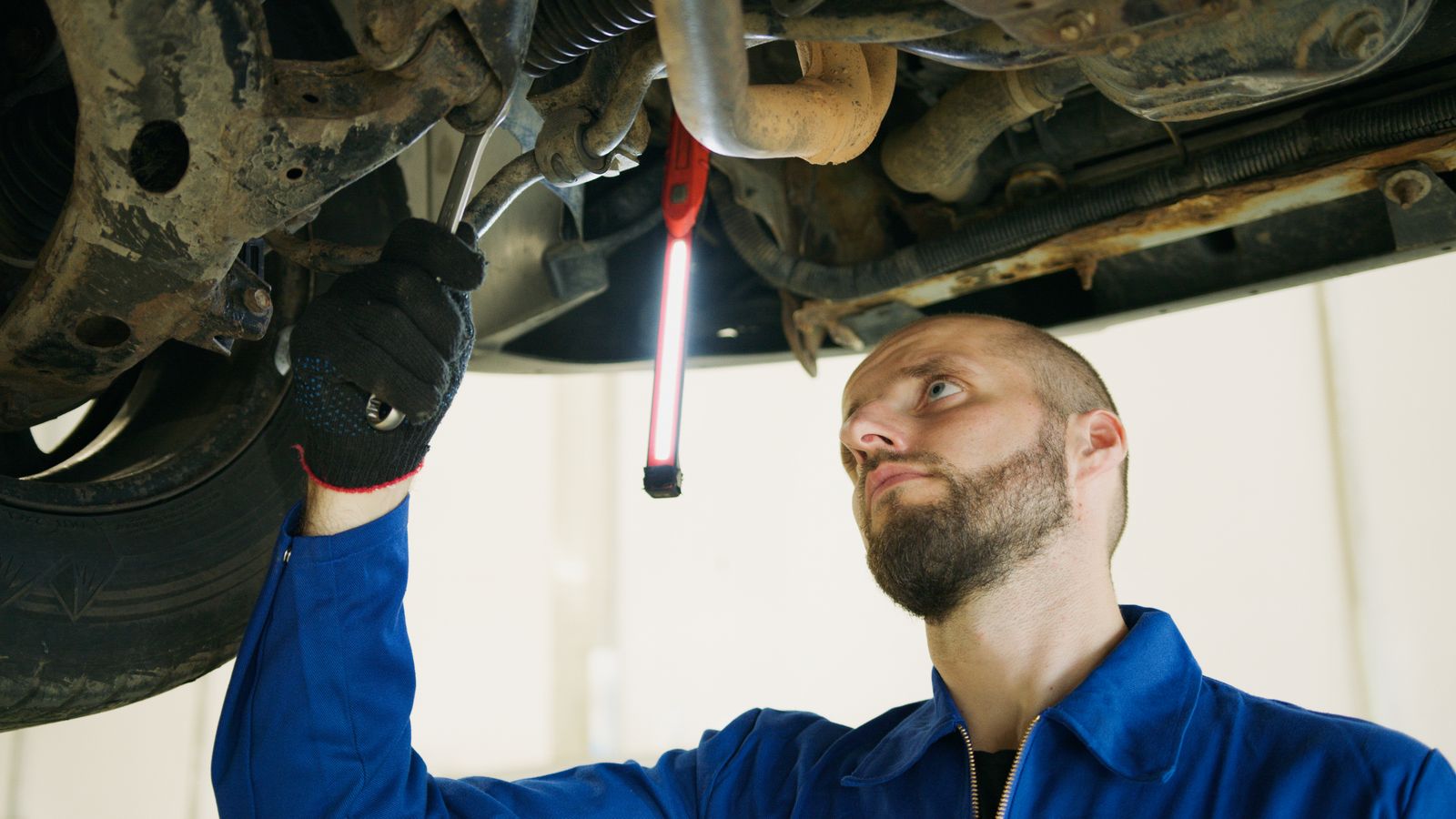
Suspension and steering issues are detected during the physical check and the underbody inspection. Worn ball joints, tie rod ends, control arm bushings, and shock absorbers are all flagged. Shock absorbers that have lost their damping ability allow the vehicle to bounce excessively, which also affects braking performance. Excessive steering play indicates wear in the steering rack or column.
How to fix it: If your car bounces excessively over speed bumps, makes clunking sounds over rough roads, or feels vague when steering at speed, get the suspension inspected before your test. The car passing related work specialists at ABBA Auto Center handle all suspension and steering repairs needed to bring a vehicle up to RTA standard. Wheel alignment should also be checked and corrected after any suspension work.
8. Heavily Tinted Windows
Window tint is one of the most common failure points for modified vehicles in Dubai. The front side windows must allow a minimum of 50% visible light transmission, and the inspector uses a tint meter to measure this. Many aftermarket tint films use darker grades than the permitted standard.
How to fix it: The only fix is removing the non-compliant tint from the front side windows and replacing it with a film that meets the 50% visible light transmission standard. This is straightforward work for any window tinting specialist.
How to Avoid All of These Failures at Once
The most reliable way to avoid every single one of these failures is to book a pre-RTA inspection check at a properly equipped garage before your official test date. A professional pre-inspection covers every item on the official RTA checklist: brakes, lights, tyres, emissions, warning lights, suspension, steering, windshield, and window tint. Any issue found is documented and can be fixed on the spot.
ABBA Auto Center is located inside the AG CARS Vehicle Testing Centre in Al Mamzar, Deira, Dubai. This means the pre-inspection and the official test can happen at the same location on the same day. The center is open seven days a week from 8am to 10pm and services all major vehicle brands. If you prefer to hand the entire process over, the RTA passing assistance service allows the team to manage the queue and test process completely on your behalf.
Frequently Asked Questions
Can a car fail RTA for having a cracked number plate?+
Yes. The number plate must be clean, legible, and undamaged. A cracked or faded plate that makes the characters difficult to read is a failure point. Replacement plates are straightforward to obtain through the RTA before your test.
What happens if my car fails the RTA test twice in a row?+
There is no automatic consequence for failing multiple times beyond the additional retest fees. However, repeated failures are a signal that the repairs carried out between tests were not addressing the actual root cause. A proper diagnostic inspection after the first failure is the right approach.
If I fix the failed items at a garage, do I have to redo the entire inspection?+
No. When your vehicle returns for a retest, only the items that failed the first time are retested. Items that passed on the first visit are not checked again. This is why getting as many items right as possible before the first visit is always the better strategy.
Does ABBA Auto Center fix issues found during the RTA test on the same day?+
Yes. Because ABBA Auto Center is located inside the AG CARS Vehicle Testing Centre in Al Mamzar, Deira, the team can carry out most standard repairs on the same day a failure is identified and then proceed to an immediate retest, significantly reducing turnaround time.
Need Professional Assistance?
Our experts at ABBA Auto Center are here to help with any of your automotive needs.
Book Your Service via WhatsApp